
Total hip arthroplasty is considered one of the most important surgical procedures of the 20th century, as it has helped millions of people regain the ability to walk. Without the normal function of the hip joint, someone can’t walk properly.
What is revision total hip arthroplasty?
Hip arthroplasty is the replacement of the hip joint, or as it was previously called, hip replacement. When arthritis and joint dysfunction are present, there is severe pain and limitation of every activity. The first hip surgeries began in Europe in the 1970s with the first generation of implants, which were made of stainless steel and had a completely different design compared to today’s implants. At that time, the expected lifespan for good function of the new joint was 10 to 15 years. Nevertheless, there are still patients today with hip arthroplasties and implants from that era that remain in excellent condition.
Revision Total Hip Arthroplasty
Wear of the implants of hip arthroplasty leads to the necessary performance of revision total hip arthroplasty. Revision total hip arthroplasty is a procedure significantly more extensive than total hip arthroplasty. This becomes understandable if one considers that removal of the existing arthroplasty may weaken the pelvic bone at the acetabulum or the femur during surgical removal.
The experience required for revision total hip arthroplasty is very great, and many times special technical means are needed in order to perform a completely successful revision total hip arthroplasty. In revision total hip arthroplasty, there is less supporting bone for the placement of the new hip joint.
Preoperative planning, particularly for this procedure, is extremely important and absolutely necessary. Good cooperation of the surgical team, as well as the established good contact with the physiotherapy and rehabilitation team, are essential.
Causes Leading to Revision Total Hip Arthroplasty
The causes that may lead someone to undergo revision total hip arthroplasty are the following. Dysfunction of the total hip arthroplasty due to loosening or wear of one or even both components of the hip arthroplasty. Also, more rarely, infection may occur on the basis of a total hip arthroplasty. In the second case, removal of the total hip arthroplasty must be performed, mechanical lavage carried out, and the use of special antibiotics administered according to the antibiogram. Revision total hip arthroplasty is a major procedure and must be performed in a large and well-organized hospital and not in a small clinic without the special infrastructure. When total hip arthroplasty procedures are performed in the best possible way, revision procedures are reduced to a very great extent.
Revision Total Hip Arthroplasty: Surgical Procedure
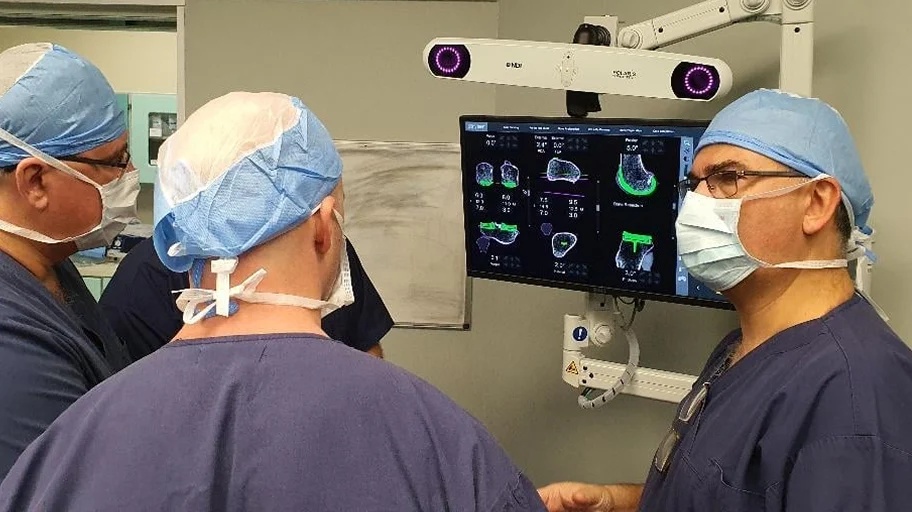
The great progress in imaging of the musculoskeletal system with CT scans and MRI, together with the tremendous development in robotic assistance and digital navigation, has greatly contributed to the accuracy of revision total hip arthroplasty. The Second Orthopedic Clinic of Hygeia, Dr. Konstantinos Dretakis and his associates are fully specialized in hip arthroplasty and in revision total hip arthroplasty. The extensive experience of the surgical team, after hundreds of difficult operations, can serve as a guarantee of a high probability of a good outcome in a revision total hip arthroplasty procedure.
Orthopedic Surgeon Dr. Dretakis
Orthopedic Surgeon Dr. Dretakis has extensive experience and uses modern techniques. He maintains a practice in Athens, Maroussi and Glyfada.
Athens | Marousi | Glyfada
Revision Total Hip Arthroplasty: Cost
Revision total hip arthroplasty procedures are covered at a percentage of approximately 30% by the state insurance funds for operations performed in private hospitals. If total hip arthroplasty is no longer functioning well and there is a need for revision, one should never hesitate or think about the possible difficulties and complications of the procedure. The decision to remain with a dysfunctional and painful hip joint leads to withdrawal, exhaustion, and depression.
The Role of the Surgeon in Revision Total Hip Arthroplasty
Revision total hip arthroplasty is perhaps one of the largest orthopedic procedures, and it is natural that, even very rarely, certain complications may occur. The two most important are infection and thrombosis, and they occur in less than 0.5%. Revision procedures may be performed more than once if this is necessary in certain cases.
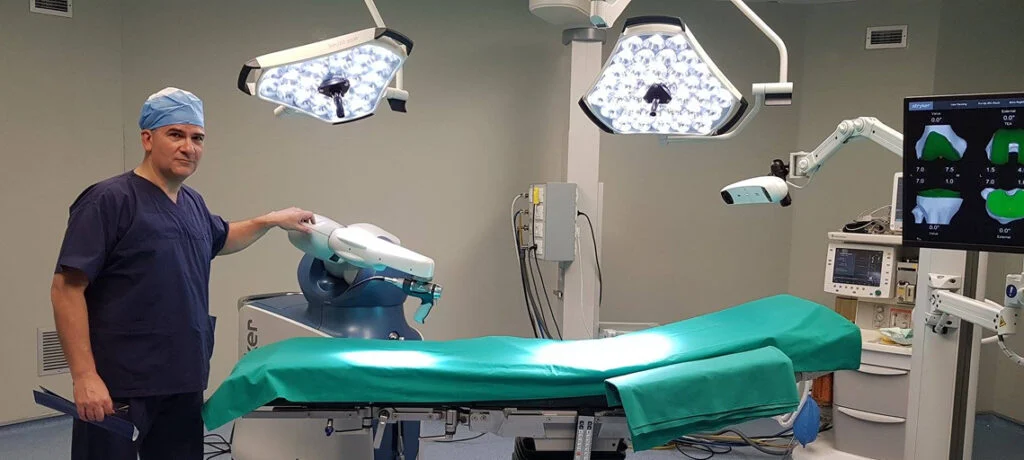
Director Dr. Kon. Dretakis, International Robotic Trainer, with the assistance of the MAKO Robotic Arm Assisted Hip Replacement system located at Hygeia Hospital, can achieve a significant improvement in revision total hip arthroplasty. Revision total hip arthroplasty can get a lot of benefit from the use of the MAKO system. Nevertheless, the use of high-resolution CT scanning used in Robotic Arm Assisted Surgery, in combination with the highly accurate system of virtual implant application in the acetabulum and the femur, can greatly assist in achieving the best possible outcome. Therefore, the robotic technology of the MAKO Stryker system can also be utilized in revision total hip arthroplasty.
Reclaim your freedom today!
We never rely on luck, but on our knowledge and experience.
make an appointmentINFORMATIONAL VIDEOS & PATIENT CASES
Visit our YouTube channel to see scientific videos and patient case studies

FAQ
-
Revision total hip arthroplasty is performed in patients who have previously undergone total hip arthroplasty, but due to wear of the implants or unsuccessful placement of the implant, replacement becomes necessary.
-
Persistent pain, difficulty in movement, infection, inflammation, and implant dislocation.
-
In private hospitals, approximately 30% of the expense may be covered by the state insurance funds, while the remaining amount is covered by the patient.
-
Robotic hip arthroplasty is also applied in revision procedures, providing detailed imaging and ensuring accuracy.
-
After total hip arthroplasty, your doctor will provide you with important postoperative instructions for rapid recovery and the patient’s return to daily activities.